

Editorial review: November 12, 2026
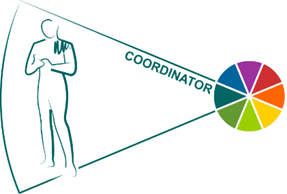
Projects depend on coordination: people need to know what is happening, why it matters and how their responsibilities connect. The Coordinator profile describes preferences for a steady, considered approach that attends to both information and relationships. It does not prove that someone will organize every project well.
Coordinator is a modern role name used in Insights Discovery’s eight-role framework. It should not be treated as an exact name for Jung’s introverted sensation type. A contemporary profile can draw on historical ideas without making the labels interchangeable.
Coordinator preferences
Someone who recognizes this profile may value preparation, a dependable process and enough information to understand a task. They may appreciate a small group of trusted colleagues while taking time to become comfortable with a new working relationship.
These are possibilities to discuss, not instructions to keep someone in familiar surroundings. Experience, trust and the requirements of the task all influence how a person works. A preference for preparation does not establish superior judgment or an inability to manage uncertainty.
Share the right information
Explain the purpose of a request as well as the steps. Make the expected result, responsibilities and decision points visible. Ask what information is missing, and distinguish an essential dependency from background detail.
An illustrative request is: “Please coordinate the handover for Friday. The goal is to give the service team the customer history and open actions. These two owners will supply the information; tell me by Wednesday if anything is missing.” That gives the person a system to work with and a route for raising a concern.
Plan change together
When the process changes, share the reason, the timing and what people need to do differently. Invite the colleague to identify a dependency you may have missed. Practical questions can improve implementation; they should not be dismissed automatically as resistance.
At the same time, agree when a decision is needed. Ask for a recommendation using the information available and make the remaining uncertainty explicit. A clear check-in can be more useful than either constant supervision or leaving the person to infer expectations.
If you recognize Coordinator preferences in yourself, make your concerns and ideas visible early. Others cannot respond to an interpretation they have not heard. Use evidence, state your view and remain open to another workable approach.
Read the eight personality types overview and explore Insights Discovery team building for ways to turn individual preferences into shared planning agreements.