

Editorial review: November 12, 2026
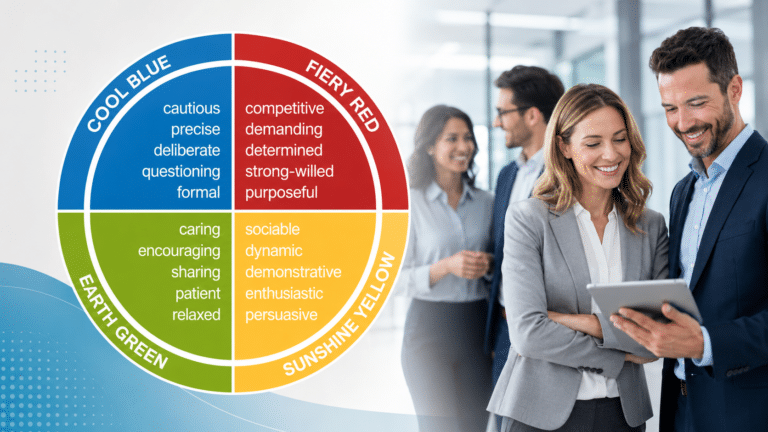
Insights Discovery uses four color energies and an eight-type wheel to discuss working preferences. This guide introduces the vocabulary and links to the individual type articles. Start with the model overview if you are new to the assessment, and treat the descriptions as prompts for a conversation rather than complete accounts of a person.
The four color energies
The four energies describe different emphases in behavior. Everyone can use all four; a preference does not determine competence, values or the job someone should hold.
- Cool Blue emphasizes analysis, detail and understanding. Ask what evidence and preparation would help.
- Earth Green emphasizes consideration, support and relationships. Ask who is affected and what concerns need to be heard.
- Sunshine Yellow emphasizes interaction, possibilities and enthusiasm. Make space for ideas while recording the agreed next step.
- Fiery Red emphasizes action, decisions and results. Be clear about outcomes, boundaries and timing.
Eight types on the Insights Discovery wheel
Director, Motivator, Inspirer, Helper, Supporter, Coordinator, Observer and Reformer are names used in the modern Insights framework. They should not be presented as Jung’s own eight role names. Jung’s historical function attitudes are explained separately in the eight function attitudes guide.
Director: Fiery Red
The Director description emphasizes deciding and moving work forward. A useful question is whether the desired result and decision authority are clear. Directness can help a team act, but listening to a concern may reveal information needed for a better decision. Read the Director profile.
Motivator: Fiery Red and Sunshine Yellow
The Motivator description brings together action and enthusiasm. Discussion may generate momentum, while a written agreement helps turn that energy into follow-through. Ask which idea is being selected and what commitment is realistic. Read the Motivator profile.
Inspirer: Sunshine Yellow
The Inspirer description emphasizes interaction and possibilities. Invite ideas, then leave time to test assumptions and decide what happens next. Enthusiasm can contribute to a project without proving that the person is suited to a particular sales or creative role. Read the Inspirer profile.
Helper: Sunshine Yellow and Earth Green
The Helper description combines a relational focus with support for others. Useful questions include who needs to be involved and whether helpful commitments are becoming too numerous. Supporting a colleague can include setting a clear boundary. Read the Helper profile.
Supporter: Earth Green
The Supporter description emphasizes consideration and continuity in relationships. Allow concerns to be expressed and explain how a decision affects people. Do not mistake a quiet response for agreement or assume that someone wants to remain out of the spotlight. Read the Supporter profile.
Coordinator: Earth Green and Cool Blue
The Coordinator description brings together a considered approach and attention to practical detail. Clarify the sequence of work and make dependencies visible. A preference for planning does not prevent someone from adapting when the reason for a change is understood. Read the Coordinator profile.
Observer: Cool Blue
The Observer description emphasizes analysis and accuracy. Provide relevant information and distinguish essential checks from details that can wait. Analytical preferences are not a qualification for a legal, financial or technical role; those require demonstrated skills and appropriate experience. Read the Observer profile.
Reformer: Cool Blue and Fiery Red
The Reformer description combines standards with action. Agree what “good enough to proceed” means and which evidence would change a decision. A focus on improvement can be useful when it also leaves room for other people’s knowledge and concerns. Read the Reformer profile.
How the wheel adds nuance
The publisher describes 72 positions on the wheel, adding detail beyond the eight broad labels. Two people in one position can still differ in their preferences and behavior. See Insights’ explanation of individual differences; the wheel is not a ranking of people or a career-selection chart.
A debrief should connect the profile to examples the participant recognizes and allow disagreement with a description. The useful outcome is an action to try—perhaps a clearer meeting request or a different feedback approach—not a requirement to behave like the label.
Use the model in a team conversation
Illustrative exercise: each team member chooses one communication habit that helps them and one that creates difficulty. Compare the requests, identify a practical agreement and choose a review date. For example, the team might agree to circulate decision questions before meetings and finish with an owner and deadline. Check whether that agreement helps the actual work rather than assuming a balanced wheel guarantees results.
Explore Insights Discovery team development or contact Discover Yourself to discuss your team’s goals.